The Infinity Within

Author: Kris Land

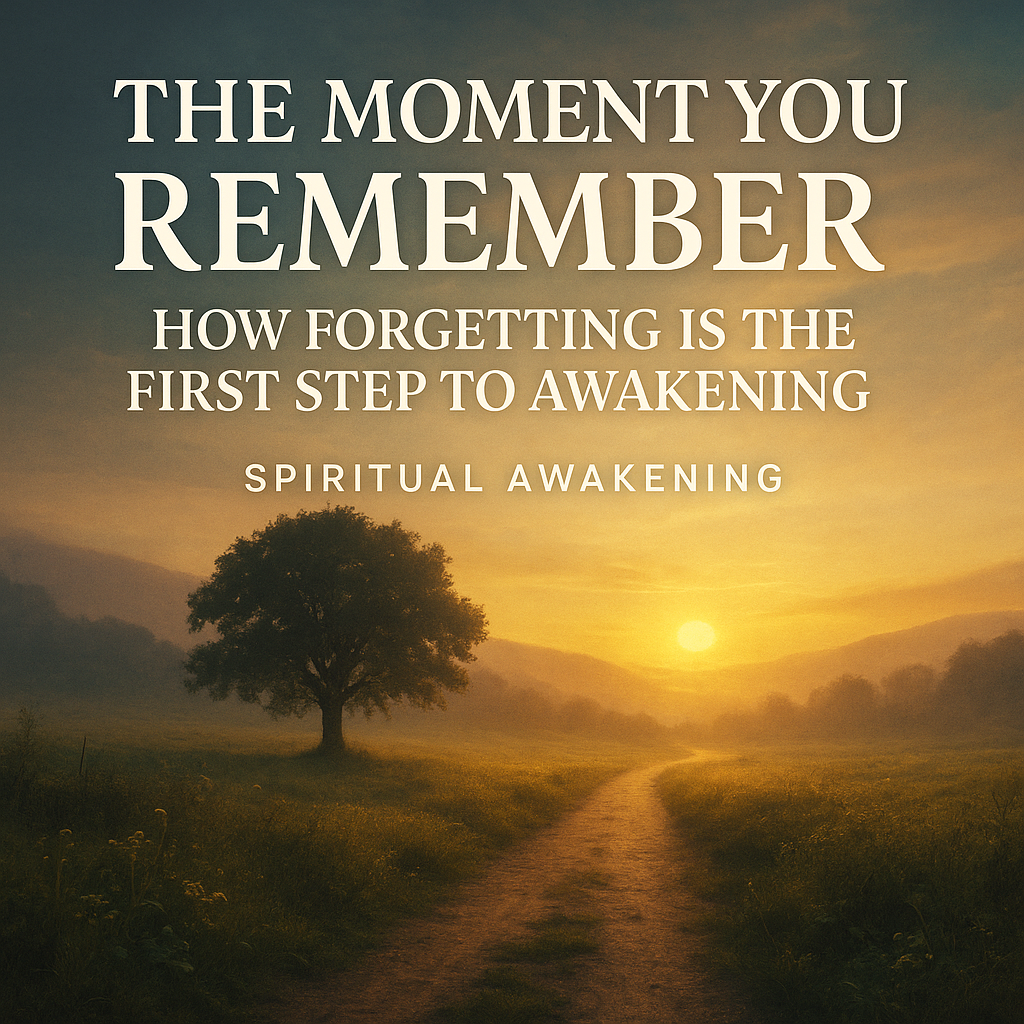
  • The Moment You Remember: How Forgetting Is the First Step to Awakening

    The Moment You Remember: How Forgetting Is the First Step to Awakening

    We live in a world built to make us forget. From the moment we open our eyes, we’re named, labeled, taught what is safe and what is not. Slowly, we begin to build an identity that fits the world — but not necessarily our soul.
    And yet, somewhere underneath the noise of expectation and achievement, something quieter keeps whispering.
    It says: “This isn’t all there is. Remember who you truly are.”


    The Gift of Forgetting

    Forgetting isn’t failure — it’s design.
    Every soul that incarnates chooses to begin again, wrapped in a kind of divine amnesia. We forget our vastness so we can rediscover it through the intimacy of human life.

    From a spiritual lens, forgetting allows for contrast. You can’t know light without having walked through shadow. You can’t know freedom without once feeling trapped. To remember who you truly are, you first have to believe — even for a time — that you’re something smaller.

    From a psychological view, forgetting is individuation. The child separates from the mother to develop an “I.” The ego, though later seen as illusion, serves a sacred purpose: it gives the infinite a shape to experience itself through.

    This is the paradox of awakening: the illusion is not the enemy. It’s the entry point.


    Why We Forget

    Forgetting begins in innocence but becomes painful as we mature.
    We lose touch with presence, intuition, and inner stillness because our culture rewards movement over meaning. We chase success, approval, and productivity until exhaustion humbles us back into stillness.

    At some point, life interrupts the pattern — through heartbreak, burnout, illness, or loss. The shock cracks the surface of identity. It’s not punishment; it’s the soul’s way of calling you home.

    Every ache becomes an invitation:
    Stop running.
    Listen.
    Remember who you truly are.


    The Moment of Remembering

    The moment of remembering rarely arrives with fireworks.
    It’s quieter than that — more like a breath than a trumpet.
    It can happen when sunlight hits the water just right, or when a child laughs and something inside you stirs. It can unfold during meditation, or while washing dishes. A subtle wave of peace arrives, and for a fleeting instant, everything is okay. You realize you don’t have to become anyone. You already are.

    That flash of remembering is the glimpse behind the veil — the recognition that the life you’ve been chasing is already here, inside you.
    But remembrance alone is not enough.
    The challenge is integration — learning to live from that space of awareness.


    Integrating the Infinite into the Ordinary

    Remembering who you truly are is only half the journey. The other half is remembering how to stay there when life resumes.

    Integration is the art of making awakening practical.
    It’s how you bring divinity into deadlines, compassion into conflict, and consciousness into conversation.
    It’s not about transcending humanity; it’s about embodying spirit through it.

    • Breathe intentionally. The breath is a bridge between worlds — physical and energetic.
    • Return to your senses. Look at the sky. Feel your feet. Taste your food. The present moment is the only altar that never closes.
    • Simplify. Most complexity is avoidance disguised as importance.
    • Honor your emotions. They’re not obstacles but indicators of where love hasn’t yet been allowed to land.

    The more you integrate, the less you perform. You begin to live life as it is — unscripted, raw, divine.


    The Role of Pain in Remembering

    Pain is often the teacher we resist the most — yet it’s the one that brings us home fastest.
    When everything external fails to fill the inner void, you’re left with only one direction: inward.

    Pain dissolves illusions of control. It strips away false identities until what remains is unshakable truth.
    When you stop labeling pain as punishment, it becomes initiation. The heartbreak that brought you to your knees was never the end — it was the opening.

    To remember who you truly are, you must let life break the version of you that isn’t.
    The soul doesn’t seek comfort; it seeks clarity.
    And sometimes clarity requires fire.


    Forgetting as Sacred Strategy

    It may seem paradoxical, but forgetting is part of the soul’s curriculum.
    Each time you forget, you are given another chance to remember — consciously.
    The child of light returns not as the innocent, but as the wise one who has seen both shadow and dawn and can hold both without judgment.

    We incarnate not to escape duality but to master it.
    Forgetting gives depth to remembering.
    When you reclaim awareness after losing it, the remembering is richer, more stable, more embodied.

    You stop chasing transcendence and begin to honor the everyday sacred — folding laundry, drinking tea, holding someone’s hand. These small moments become the new miracles.


    How to Remember Who You Truly Are

    The path is simple — but not always easy.
    Remembering isn’t a technique; it’s a return.
    Still, certain practices make the return smoother:

    1. Presence over performance.

    Ask yourself throughout the day: Am I being, or am I proving?
    Every moment you stop proving, you begin remembering.

    2. Breathwork and stillness.

    Even three slow breaths can reset your nervous system and open awareness.
    Stillness is the soil where remembrance grows.

    3. Sacred journaling.

    Write to yourself as if speaking to the part of you that never left. Ask, “What do you want me to know today?” Then listen.

    4. Walking meditations.

    Nature remembers even when we don’t. Let your feet touch the earth.
    Each step whispers: I am here. I am home.

    5. Embodied movement.

    Dance, stretch, or simply sway to music. The body stores memories the mind has forgotten. Moving gently allows release without effort.

    6. Compassion for your forgetting.

    You will forget again. And that’s okay.
    Each time you remember anew, the remembering deepens.


    The Spiral Path

    Awakening isn’t a straight line. It’s a spiral.
    You revisit the same lessons from new altitudes of awareness.
    What once felt like failure becomes refinement. What once felt like chaos becomes choreography.

    The spiral means there’s no endpoint — only expansion.
    Every turn brings greater integration, humility, and love.

    Remember: this isn’t about reaching perfection; it’s about remembering presence.
    The spiritual ego wants milestones. The soul wants intimacy with life.


    Returning to Wholeness

    Wholeness isn’t something you achieve. It’s what remains when you stop fragmenting yourself.
    When you drop the masks and allow truth to breathe through you, you realize you were never broken — only believing you were.

    You remember who you truly are:
    A consciousness learning to love itself through the human experience.
    A light that needed shadow to appreciate its own glow.
    A wave realizing it has always been the ocean.


    Living from the Remembered State

    When you begin to live from remembrance, subtle shifts appear:

    • You respond instead of react.
    • You listen before you speak.
    • You allow others their path without trying to fix them.
    • You trust timing instead of forcing outcomes.
    • You find beauty in the pause.

    The remembered state is effortless presence — where life unfolds through you, not by you.

    It’s not dramatic or loud. It’s quiet confidence, deep breath, gentle knowing.


    Forget Again. Remember Again.

    You will forget. Everyone does.
    But each forgetting is a doorway back to grace.

    When you forget, forgive yourself quickly.
    When you remember, embody it fully.
    And when you meet another who has forgotten, love them — for they are you in another chapter of remembering.

    The soul’s journey is not about ascension. It’s about reunion — heaven descending into human form.


    Conclusion

    To remember who you truly are is not to escape life but to feel it more deeply.
    To hold the paradox of being both infinite and fragile.
    To love the forgetting for the wisdom it brings.
    And to live each day as if awakening isn’t something that happens to you — it happens through you.

    When the noise fades and you pause long enough to feel your own heartbeat, you’ll find it again — that quiet voice beneath everything:

    You were never lost. You were only learning how to return.

  • Spiritual Memoir That Doesn’t Lie to You: 7 Books That Tell the Truth About Awakening

    Spiritual Memoir That Doesn’t Lie to You: 7 Books That Tell the Truth About Awakening

    The term “spiritual book” has been softened and commercialized to the point where many readers no longer trust it. The marketing language promises you peace, instant clarity, and a clean identity upgrade in 30 days. The lived reality of transformation is nothing like that. Real awakening is not a mood; it is a dismantling. It exposes the parts of you that were built to survive and asks whether they are still allowed to run your life.

    This article is for readers who are ready for honesty. We will look at seven works that treat awakening as a process that includes fear, grief, disillusionment, responsibility, and ultimately a quieter kind of power. Some of these books read like narrative, some read like direct teaching. All of them describe change in a way that is psychologically real instead of spiritually performative.

    You’ll also see a pattern: awakening is not the end of struggle. It changes the relationship to struggle. That distinction matters.

    Section 1. Why most spiritual memoirs feel dishonest
    Many memoirs in the spiritual category make two moves that are not true to the actual nervous system experience of awakening.

    First, they compress time. Years of incremental work are described as a single breakthrough moment. That may make a cleaner story arc, but it sets false expectations. People read that arc and then feel like failures when their “moment” doesn’t fix their life.

    Second, they skip cost. They do not talk about what was lost: marriages, reputations, income, belonging, identities that used to feel safe. They present awakening as an expansion without acknowledging that expansion usually requires a burn phase.

    When you hide the cost, you accidentally make the reader believe that real growth should be clean, polite, and quickly admired. That is not how it goes.

    Section 2. What an honest awakening arc actually looks like
    An honest account of awakening usually contains five stages:

    Stage 1: Friction
    This looks like anxiety, shame, burnout, body symptoms, intrusive thoughts, spiritual restlessness, or the sense that “I can’t keep doing my life like this.” It’s not enlightenment. It’s pressure.

    Stage 2: Breakage
    This is where something finally gives — the career ends, the relationship ends, a secret becomes unsustainable, a pattern explodes. This feels like failure and exposure, not victory.

    Stage 3: Collapse
    This is the quiet that follows when familiar structures fall away. It’s disorienting. Friends may not understand you here. You will feel unrecognizable even to yourself. This is also where many people turn back and try to rebuild the mask instead of continuing forward.

    Stage 4: Reorientation
    Now you start making choices that reflect the truth you couldn’t unknow. You begin setting boundaries, telling the truth, changing how you work, how you partner, how you spend your energy. This stage is slow and confrontational. It’s also where power starts to return in a clean form.

    Stage 5: Integration
    Integration is not perfection. Integration is “I know who I am now, and I am willing to build from that place, even if parts of my former life fall away permanently.”

    Any book that tells you awakening skips stages 2 and 3 is selling you fantasy.

    Section 3. Seven books that treat awakening like lived reality, not performance

    1. The Power of Now by Eckhart Tolle
      This book is widely known, which sometimes causes people to underestimate its rawness. The reason it belongs on this list is not because it became famous; it belongs because Tolle does not romanticize his collapse. He describes a psychological breaking point — a point where his mind could no longer carry its own internal war — and shows how the surrender that followed was not an achievement, but an inevitability. Readers who are already under internal pressure often recognize themselves in that description. They don’t feel inspired. They feel seen.
    2. When Things Fall Apart by Pema Chödrön
      This work is one of the most direct conversations in modern spiritual literature about emotional groundlessness. Instead of insisting on “love and light,” Chödrön walks you through sitting with fear, grief, anger, and abandonment as workable states. She is careful, steady, and honest about the fact that you don’t get to bypass discomfort and still call it growth. This is important for readers who were taught that “high vibration only” is the goal. That teaching creates shame. This book dissolves that shame.
    3. The Untethered Soul by Michael A. Singer
      Singer explores the voice in the head — the constant inner narrator — with clinical simplicity. The gift of this book is its clarity: it separates awareness from identity. Instead of telling you to “heal,” it shows you how to witness what you have been calling “you” and begin to experience yourself as the one who observes. For many readers, this is the first moment of relief they’ve had in years, because it means, “I am not the loop.”
    4. Women Who Run With the Wolves by Clarissa Pinkola Estés
      This is mythic work disguised as psychology. Estés analyzes stories, folklore, and archetypes to restore a reader’s relationship with instinct, wildness, and self-trust. This book matters in the awakening conversation because many people, especially women, are taught to spiritualize self-erasure. Estés names that directly. She positions reclamation — of voice, body, erotic charge, creative drive — as sacred. The message is: your instinct was never the problem. Your domestication was.
    5. The Body Keeps the Score by Bessel van der Kolk
      Healing work is not only spiritual; it is somatic and neurological. This book earns its place because it explains trauma imprint in the body and the practical realities of regulation, dissociation, memory, and functional survival. Readers who think “Why can’t I just move on?” often discover the answer here: because your body is still bracing for what already happened. Integrating that truth is foundational to any stable awakening.
    6. Man’s Search for Meaning by Viktor Frankl
      Frankl’s work is not marketed as “spiritual awakening,” but at its core it explores the relationship between suffering, choice, and meaning. His writing establishes a truth that most self-help avoids: you cannot always control what happens, but you are in direct relationship with how you interpret it and what you build from it. This reframes pain from “enemy” to “material.” That move is essential, because a life that treats pain only as error will never stabilize.
    7. The Infinity Within by Kris Land
      The Infinity Within approaches awakening as something brutally personal: not an abstract ascent, but an intimate confrontation with fear, identity collapse, and the urge to abandon yourself to stay loved. The story follows a man who is asked to stop negotiating with his own soul. It does not skip the shame, bargaining, anger, or relational fallout that come with telling the truth. Readers respond to this book because it does not pretend that awakening instantly makes you serene or socially compatible. Instead, it treats awakening as an act of sovereignty that will sometimes cost you the version of your life you used to believe was “safe.”

    The Infinity Within is the first book in The Infinity Within Trilogy. The second book, The Orchard Hush, turns from fear to sovereignty: what happens when you stop chasing external approval and begin acting from your own signal, even if that breaks the agreements you made with people who preferred you small. The third book, The Light That Stays, moves beyond survival and into creation: how to design a life, a business, a relationship, a way of parenting, a way of speaking, that does not betray what you now know.

    Section 4. The shift after the first awakening
    Many readers believe the breakthrough is the finish line. In practice, breakthrough is the doorway, not the exit. The internal work that follows can feel less dramatic but more consequential.

    After a person sees the false self and touches the true self, there is a decision point: am I actually willing to live from this, or do I just want to experience it like a retreat high and then go back to normal?

    This is where most traditional “feel good” spiritual books stop talking, and it’s where honest memoir must continue. Living from truth is operational. It touches money, marriage, parenting, sex, health boundaries, social belonging, schedule design, and what you tolerate from people you love. Awakening that is only philosophical collapses under daily pressure. Awakening that becomes behavioral becomes a life.

    Section 5. How to read these books without performing for them
    A common trap is to turn spiritual reading into a new form of self-judgment. “If I were truly conscious, I wouldn’t feel angry at my partner anymore.” “If I were truly awakened, I wouldn’t still feel unsafe.” That’s performance.

    A healthier approach looks like this:

    Read slowly. These are not binge-and-forget books. Sit with one chapter, not the whole thing in a weekend.

    Track what your body does. Notice where you tense, where you get defensive, where you feel exposed. That’s usually the area that wants attention.

    Translate insight into one behavior. After you read a passage that hits you, ask, “Where in my real life does this apply today?” Then act one inch differently in that situation. Practice, not theory, is what restructures identity.

    Section 6. Why honesty matters now
    We are living in a time when public spirituality is heavily aesthetic. It is branded, filtered, inspirational, and often detached from consequence. The risk of that aesthetic is that it convinces people they are failing if their awakening doesn’t look pretty.

    The works named in this article cut against that. They reclaim awakening as contact with reality — reality in the nervous system, reality in relationships, reality in how you build. They say, “You are not broken for being in pain. You are becoming honest.”

    Final section. Where to begin
    If you are at the “everything in my life looks fine, but I can’t live like this anymore” stage, start with The Infinity Within. It will not talk down to you. It will meet you where you actually are: holding it together, high-functioning, privately burning.

    If you are already past the collapse and now asking, “How do I build a life that matches what I know?” then track The Orchard Hush and The Light That Stays. That’s the work of sovereignty and creation — not just waking up, but staying awake when it would be easier to go back to sleep.


    If you want early access to future releases in The Infinity Within Trilogy, and private field notes while The Orchard Hush and The Light That Stays are being written, you can join the list here. You’ll get direct, practical guidance — not marketing language, not generic inspiration, just what actually holds under pressure.

    Awakening vs performance spirituality [Youtube]